
CPL / City Photography League
City Photography League (CPL) Milestones
City Photography League (CPL) Milestones
Preface
City Photography League (CPL) takes the “city” as the basic unit to connect city-based photography societies, institutions, and organizations with independent legal status. CPL emphasizes innovation and creation as drivers of photographic development, and it advances public, verifiable action and world-record-oriented goals through a “99+1” interactive method.
Phase I — Origins and Institutional Foundations (1985–1992)
1985 — An institutional starting point for youth photography organizations
On June 17, 1985, at the Jinjiang Hotel in Chengdu, the Sichuan Youth Photographers Association was established. More than 800 young photographers from cities/prefectures across the province attended. The provincial party secretary wrote the association name and inscribed “Painting and Photography as One.” The congress produced its presidium through secret ballot and on-site counting, and removed intermediate structures such as a “standing council,” shaping an organizational tradition that emphasizes openness and rules.
1987 — Entering the public sphere through action
In 1987, with support from the provincial party committee and government, the “Sichuan Women’s Bicycle Photography Expedition Team” was formed. The team crossed the Qinling Mountains northward, crossed the Yellow River eastward, and conducted photographic fieldwork in four revolutionary base areas. Written support was issued by multiple local governments. In Beijing, the municipal government held a major entry ceremony in Tiananmen Square after the decade of the Cultural Revolution.
1988 — Exploring a team-competition mechanism
In May 1988, a photographic team-versus-team contest involving 12 photography teams from 8 provinces/regions was led and organized. With approval, the “Western Photography Alliance” was established, opening a new model for team competitions.
Phase II — Systematization and Professional Infrastructure (1993–1999)
1996 — “Mass Photography” and entry into a national professional qualification system
On June 17, 1996, at the 11th anniversary celebration, the “Grand Photography Theory” of “Mass Photography” was proposed. On December 23 of the same year, the organization entered the national vocational skills assessment system (“121 National Vocational Skills Appraisal Station”), gaining accreditation to assess photographers from junior level through technician.
1997 — Cross-disciplinary exhibitions and organizational renewal
On March 20, 1997, China’s first joint exhibition of “Women Painters · Women Photographers” opened in Chengdu. On October 22, a member-representative congress was held and a chair transition was completed.
Phase III — City Photography Congress and Platform Formation (2000–2009)
2004 — The City Photography Congress and the rise of an “Eastern Photography Platform”
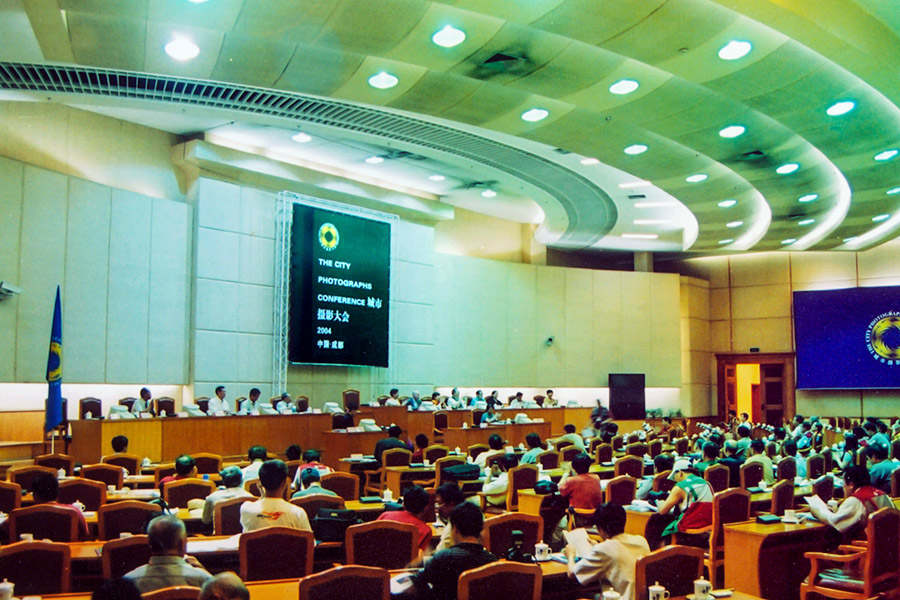
In 2004, the first City Photography Congress was held in Chengdu. It was described as a major social action under the “Mass Photography” concept, and recorded with the statement that “what is left to history is that the world had its first Eastern photography platform—CPL City Photography League.”
2006 — Inter-city cooperation and international participation mechanisms
On September 21, 2006, the third City Photography Congress convened in Nanjing. 23 cities from China and abroad co-organized the “Image Exhibition of Famous Cities in China and Abroad,” with overseas photographers participating.
2007 — Public heritage-making: the photographers’ “Handprint Wall”
In 2007, the fifth City Photography Congress was held in Chongzhou, Chengdu, emphasizing “photography presses the shutter for the city.” A “Handprint Wall” was created at the head of the Langqiao Bridge in Chongzhou, described as the first such handprint wall of photographers in the world, accompanied by extensive dissemination and compiled reports.
Phase IV — Rule-Based Governance and Cross-Disciplinary Innovation (2010–2014)
2010 — “Clear rules” and an action framework for “contemporary photographic cultural heritage”
On November 28, 2010, a Nanjing working expanded meeting proposed: building contemporary photographic cultural heritage, promoting the “Grand Photography” theory and the “99+1” interactive behavior, and “fully advocating clear rules and opposing hidden rules.”
2011 — Intellectual property and “clear-rule” competitive experiments
On January 12, 2011, “Panda Script” and “Real-Name Landscape” received national intellectual property protection. On April 17, the “Contemporary Painter Behavior Grand PK with Heavy Rewards” (a clear-rule competitive experiment) was launched as a global pilot contest.
2014 — International node: the Hong Kong meeting and a legal support system
On January 7, 2014, an enlarged presidium meeting was held in Hong Kong to mark the tenth anniversary of the league and to make the decision to “do what is immediate, and also do what is historical.” On February 1, a “Grand Lawyers Group” composed of law firms and lawyers from multiple locations was established, described as an early initiative of a photography group to protect the legal rights of member teams.
Phase V — Public Good, Cultural Heritage, and Global Narrative (2015–2021)
2015 — A world record in long-term public-interest distribution
The “Photography Newspaper” (later evolving into “City Photography”) was certified as a world record for “the longest time a photography newspaper has been distributed free of charge.” Its origins are traced back to July 1985, with publication on the 1st and 15th of each month and long-term free distribution.
2012 — A large-scale public-interest action: free portraits for farmers with framed gifting
In 2012, more than 1,700 photographers spent half a year providing free portraits to over 12,800 farmers, printing on site, framing, and gifting the photos. “Caring Photographer” medals were awarded. This was recorded as a “world first” in scale for a social public-interest action.
2016 — “Pricing paintings with stated reasons” as a clear-rule practice
In 2016, eight Real-Name Landscape works were priced at RMB 30 million based on “three reasons,” and offered to the public for sale. The text also stated: except for organizational fees, the remaining funds were intended to be donated to build the “Eastern Five Arts Harbor” to promote cross-disciplinary art development, with an open rule that “if the reasons are refuted, the works will be transferred to the refuter free of charge.”
2017 — Cultural-heritage upgrade: “Integrity Mountain” and a stone formation
In 2017, “Integrity Mountain” appeared at Songyang Mountain in Quanzhou, with inscriptions written by member units worldwide, described as a contemporary cultural heritage integrated into history. The same year also referenced a “Sixth City Photography Congress” node.
2020–2021 — Research bases and content projects
On September 12, 2020, the “China Panda Script Research Base” was established at a grassroots public cultural organization. On June 3, 2021, filming for “Story of Long Xuming” commenced at the base.