
CPL / City Photography League
Rule-Based Pricing in Eastern Painting: CPL ‘Real-Name Landscape “Eastern Charm”’ RMB 30 Million Public Sale and Global Refutation Challenge
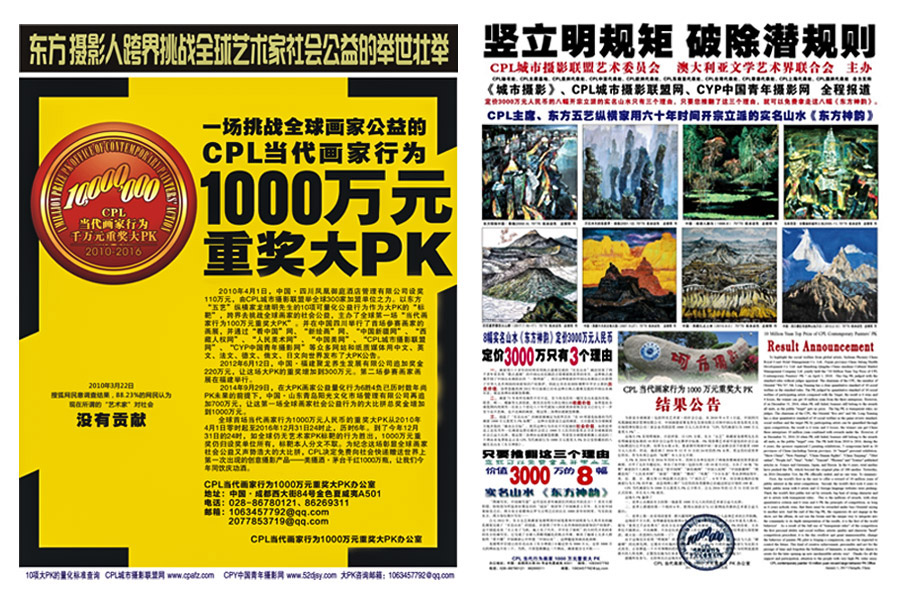
Rule-Based Pricing in Eastern Painting: CPL ‘Real-Name Landscape “Eastern Charm”’ RMB 30 Million Public Sale and Global Refutation Challenge
Preface
This is not a conventional art transaction. It is a public declaration addressed to the world: CPL uses “clear rules” to confront hidden rules. CPL first established a “RMB 10 million Grand Reward PK” through quantifiable public-interest action, and over six years no winner emerged. CPL then extended the same verifiable method to pricing: the CPL Art Committee and the Australian Federation of Literary and Art Societies priced eight Real-Name Landscape works, “Eastern Charm,” at RMB 30 million, with only three reasons, and publicly invited global refutation.
CPL’s public sale of eight “Eastern Charm” Real-Name Landscapes for RMB 30 million is not an attempt to reduce art to price. It places value on a publicly verifiable scale: the pricing reasons are disclosed; the challenge path is disclosed; the outcome can be refuted. Any institution or individual may judge accordingly and bear the consequences of that judgment. After a sale, only RMB 5 million is retained as an organizational fee; the remaining RMB 25 million is donated on site to build the “Eastern Five Arts Harbor” as long-term public infrastructure for cross-disciplinary art. The artist takes none of the proceeds; taxes and fees are borne separately by each party. A purchase therefore becomes not only a collecting action, but also a public cultural investment that is auditable, communicable, and inheritable.
Phase I — Problem Statement: Returning Art to Verifiable Public Responsibility (2010)
01 — 2010-03-22: Public opinion as a trigger
Records note that an online survey showed 88.23% of respondents believed that so-called “artists” at the time made no contribution to society. This background was used as a trigger to “redefine artist behavior by social responsibility.”
02 — 2010-04-01: Project initiation — “First Contemporary Painter Behavior PK with a RMB 1 million reward”
CPL decided, with support from media at home and abroad, to launch the “First Contemporary Painter Behavior PK with a RMB 1 million reward.” The program emphasized ten “targets” (benchmarks) as references. Participants would enter PK with their own paintings and “best social behavior and evidence.” Organizers and the award sponsor would undertake exhibitions, publications, and related work.
Phase II — Mechanism Establishment: Public PK and Transparent Judging (2010–2016)
03 — 2010-12-16: Publication of rules and office system
For the RMB 1 million stage, records state: the award sponsor exclusively funds the award; the benchmark individual does not participate in winning; if the PK does not produce a result, the award remains with the sponsor. Office locations and responsible-person structures were published together, with plans for multi-city exhibitions and final presentation.
04 — 2011-04-17: First competition launch (Du Fu Thatched Cottage Museum, Chengdu)
The “world’s first contemporary painter behavior PK with clear rules and a RMB 1 million reward” launched in Chengdu and held an exhibition for eligibility. Records state that participating artists came from multiple countries (including France and Thailand), totaling 23.
05 — 2012–2016: Upgrade to RMB 3 million / RMB 10 million rewards, with no winner for six consecutive years
For the RMB 3 million stage, the rule specified comparison against ten quantifiable benchmarks, with a 6 wins / 4 losses rule to determine the grand prize, and minor prizes awarded for winning any single benchmark.
For the RMB 10 million stage, a “special note” stated that from April 1, 2010, six years had passed; the ten benchmarks and 6 wins / 4 losses rule remained; in the final year, both Eastern and Western artists were publicly invited.
Related narratives further stated that, to promote Real-Name Landscape, a RMB 10 million reward was set using ten quantifiable public-interest criteria and disseminated globally in multiple languages; over six years, no winner emerged.
Phase III — Transaction Declaration: RMB 30 Million Sale and the Clear-Rule Clause of “Refute and Obtain Free of Charge” (2016)
Core object: eight Real-Name Landscapes, “Eastern Charm” (priced at RMB 30 million)
Records specify: the first group of Real-Name Landscapes for sale—eight works of “Eastern Charm”—is priced at RMB 30 million, with statements describing rarity and a value path (including emphasis on “rarity and appreciation speed”).
Use of funds: public construction rather than personal profit
The rule for fund allocation after sale is explicitly written: RMB 5 million belongs to the selling unit and individuals; RMB 25 million is donated on site by the painter for land acquisition to build the Eastern Five Arts Harbor; both parties pay their own taxes and fees; the artist retains none.
Refutation mechanism: a global public challenge (the “three reasons”)
The critical element is not the asking price, but refutability. Records state: if the three pricing reasons are refuted, the refuter may take the eight works of “Eastern Charm” free of charge.
The same rule is restated in “Eastern Five Arts Strategists” materials: except for organizational fees, the remainder is used to donate and build the Eastern Five Arts Harbor; the artist takes none; once the three reasons are refuted, the works are transferred to the refuter free of charge.
International dissemination: rolling publication across platforms
The reward and rule announcements were disseminated via “rolling publication across ten networks,” including Sina, Tencent, Sohu, Phoenix, Toutiao, NetEase, UC Headlines, Yidian Zixun, Baidu, Meipian, WeChat, and CPL/CYP related websites.
Phase IV — Project Vision: Turning a Transaction into a Long-Term Public Project
The planning for the “Eastern Five Arts Harbor” was described as including an “Eastern Five Arts University,” “Eastern Five Arts Museum,” and an “Eastern Five Arts Cultural Heritage Research Institute,” among other institutional concepts. Multiple categories of “research groups” were proposed, including an “Eastern Painting Real-Name Landscape Research Group” tasked with in-depth study of Real-Name Landscape, Panda Script, and the “One Painting, One Method” theory.
Purchase and institutional cooperation
The RMB 30 million sale and refutation challenge for “Eastern Charm” is open globally to participants of any nationality, ethnicity, age, gender, or occupation. Transaction rules and fund usage are constrained by public terms, with emphasis on separate tax responsibility and transparent verifiability.
For cooperation, collection inquiries, media interviews, or submission materials to “refute the three reasons,” please contact the CPL Contemporary Painter Behavior RMB 10 million Grand Reward PK Office:
Email: cityphoto1985@gmail.com
Phone: +86-28-86780121
Milestone Cards
2010-03-22 — Public opinion trigger: 88.23% questioned artists’ contribution.
2010-04-01 — RMB 1 million PK initiated: method established via ten benchmarks and evidence-based PK.
2011-04-17 — First launch: Du Fu Thatched Cottage Museum (Chengdu), eligibility exhibition with 23 participating painters.
2010–2016 — RMB 10 million PK: ten benchmarks, 6 wins / 4 losses, six years without a winner.
2016 — RMB 30 million sale and refutation challenge: refute the “three reasons” to obtain the works free of charge; RMB 25 million used to build the Eastern Five Arts Harbor; the artist retains none.
Data Snapshot
(As documented) an online survey indicated 88.23% of respondents believed “artists” at the time did not contribute to society.